Are you wondering why decryption has different prices? Both involve cracking the password. The cheapest option is to retrieve the password, and the most expensive option is to retrieve the password. Why are there so many differences?
To answer the question, first understand the decryption principle. There is only one way to decrypt, which is enumeration cracking. Commonly used passwords are basically patterned or set the same as other passwords, such as other website passwords. In this case, they can be cracked using a dictionary.
Please read the relevant introduction on the webpage carefully; sharpening your axe doesn't delay the work of chopping wood. The brute-force method of cracking is theoretically universal and can definitely crack the ciphertext. The main question is whether taking too long is meaningful.
Because most password cracking tools are extremely slow and support few password cracking protocols, brute-force cracking can take up to a year to crack some passwords. Using a dictionary requires the plaintext password to be in the dictionary, and a large password dictionary is a waste of time, so it's common for it to fail. Below is a recommendation for the world's fastest password cracking tool.
Hashcat claims to be the world's fastest password recovery tool. It had a proprietary codebase until 2015, but is now released as free software. Versions for Linux, OS X, and Windows can use CPU-based or GPU-based variants. Hashing algorithms that support hashcat include Microsoft LM hash, MD4, MD5, SHA family, Unix encryption format, MySQL, and Cisco PIX, among others.
hashcat supports multiple compute cores
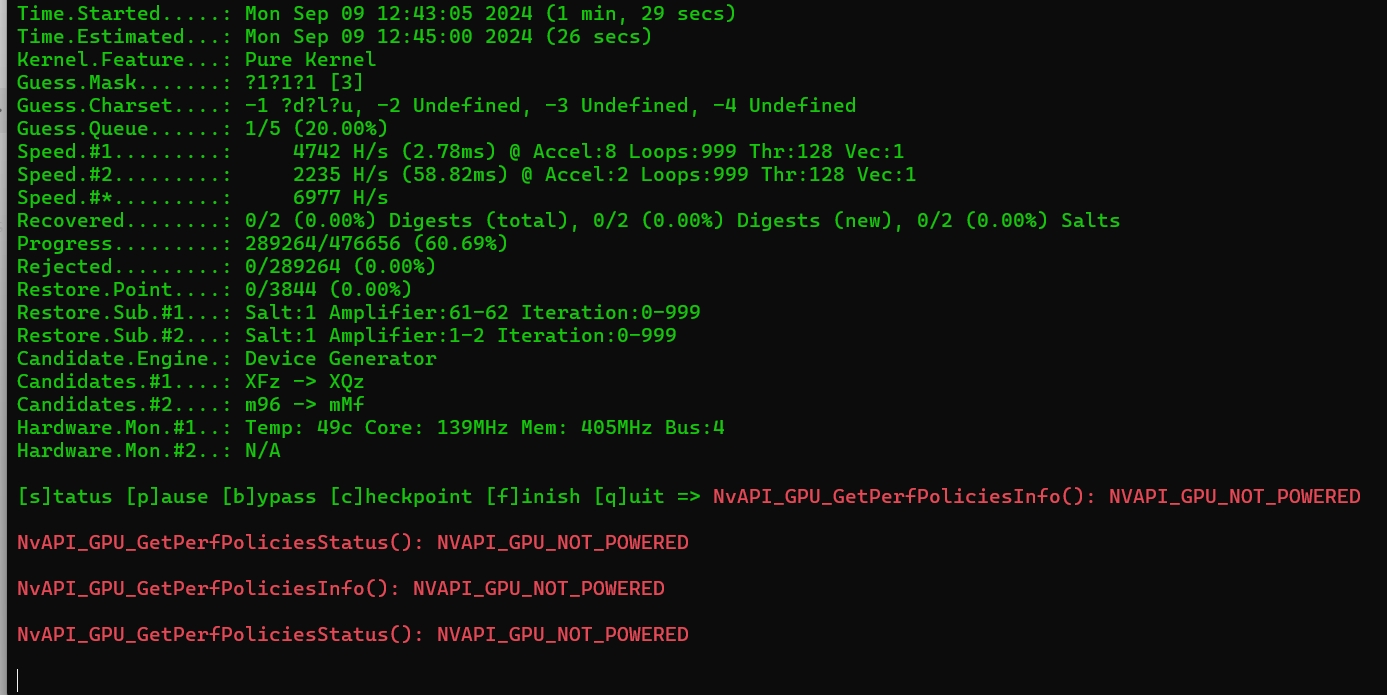
NvAPI_GPU_GetPerfPoliciesInfo(): The NVAPI_GPU_NOT_POWERED error typically indicates that the NVIDIA GPU is NOT POWERED, or is in a power-saving state. Possible causes include
The error message clEnqueueNDRangeKernel(): CL_MEM_OBJECT_ALLOCATION_FAILURE is related to OpenCL (Open Computing Language), indicating that a memory ALLOCATION FAILURE occurred while attempting to execute a kernel using clEnqueueNDRangeKernel. This is usually because the program cannot allocate enough memory on the GPU or CPU to perform the specified operation.
How many password combinations are there in all 14 digits?
To calculate all possible combinations of 14-bit passwords, you first need to clarify the following factors:
Character set size: The possible character set for the password (e.g., numbers, lowercase letters, uppercase letters, special characters, etc.).
This error message indicates that there was an insufficient memory condition when initializing the device (such as the GPU), causing the OpenCL command clEnqueueNDRangeKernel() to fail memory ALLOCATION (CL_MEM_OBJECT_ALLOCATION_FAILURE). This is usually related to insufficient available memory for the GPU, possibly due to the following reasons:
hashfile is empty or corrupt" The error message usually indicates that the hash file you are trying to use is either empty or corrupt. This error may occur in the following situations:
1. Open the installation package for installation. It is recommended not to install it on the C drive, and to create a separate installation folder.
2. Open the software after installation.
3. Find the "Range" option and check the possible range options. It is recommended to use numerical cracking first, and then gradually increase the difficulty.
4. Locate the "Length" option and set the password length. The minimum password is usually set to 1, while the maximum can be set based on your guess of the password, usually 10.
5. Click the "Open" option to find the compressed file you need to crack.
6. Click "Start"
 Document Password Recovery Master